Why Can’t You Sleep at Night?
You’ve spent the last ten hours sitting in front of a screen. You’ve barely moved, except to go to the bathroom or get a coffee. Rationally, you should be relaxed. But, when you lay your head on the pillow, your body feels like a lead statue and your mind feels like a Formula 1 racetrack. Thoughts tumble over each other, anxiety tightens your chest, and when the alarm rings in the morning, you wake up feeling more tired than when you went to bed.
If you suffer from this chronic exhaustion and insomnia, you’ve probably tried everything: relaxing teas, meditation apps, hot baths, and even turning off screens two hours before bed.
If these solutions have failed, don’t blame yourself. The problem is not your discipline or your ability to relax. The problem is that you are trying to fix a deep biological mismatch by treating your body as if it were a defective machine.
An extraordinary discovery about our evolution reveals that your insomnia is not a manufacturing flaw; it is merely a highly efficient survival instinct operating in a world for which it was not designed.
The Science Behind the Paradox: Mental Exhaustion vs. Physical Fatigue
To understand why your brain refuses to shut down, we need to take a trip back in time.
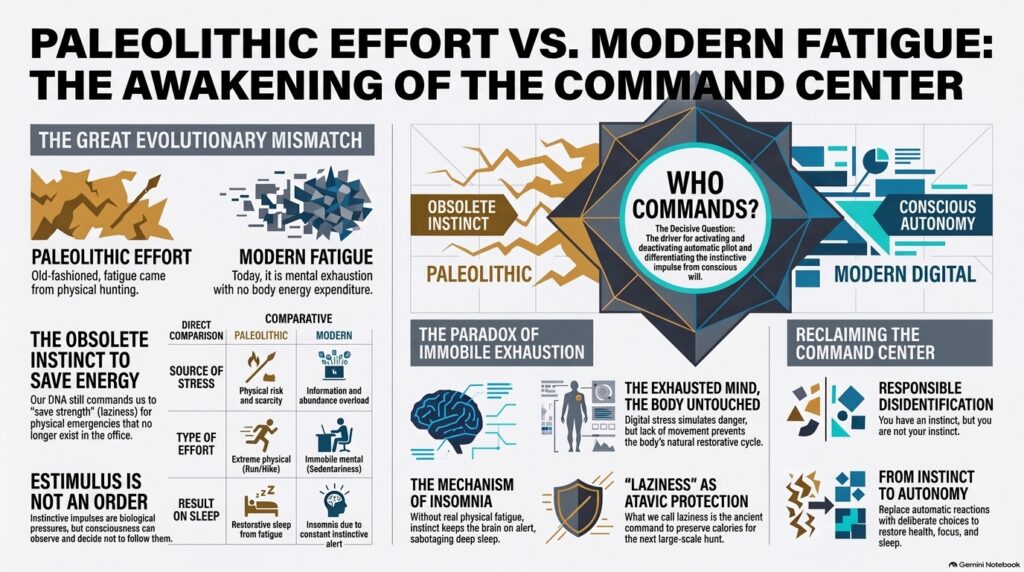
For hundreds of thousands of years, the daily routine of a human being involved extreme physical effort. Women walked miles carrying weight during paleolithic gathering; men ran, hunted, and faced real dangers to secure dinner. Deep, restorative sleep was not something our ancestors needed to “induce” with relaxation techniques: it was the inevitable biological consequence of a physically exhausted body.
Today, the scenario has changed drastically. We exhaust our minds solving complex problems, dealing with deadlines, and processing thousands of digital stimuli per second. However, our physical bodies remain motionless.
The result? A dangerous mismatch. Your brain has accumulated the stress of “fight or flight” all day long, but your body hasn’t spent the necessary physical energy. Your biological instinct, which still operates by the rules of the Stone Age, is still there. Without spending this accumulated physical energy, it wreaks havoc and you don’t sleep.
The Intellectual Alibi: Why “Laziness” is an Obsolete Survival Command
“But if I know I need to exercise to tire my body and sleep better, why do I feel such a strong force pulling me to the couch?”
This physical resistance that we usually call laziness also has a liberating scientific and evolutionary explanation. In the paleolithic period, calories were extremely scarce and difficult to obtain. Because of this, the human genome developed a crucial instinctive command: save energy at all costs whenever we were not hunting or gathering.
If you were safe in the cave, the biological command was to stay still to preserve your strength.
The problem is that your energy-saving instinct still thinks you live in the savanna. When you decide to go to the gym after a tiring day of mental work, this ancient automatism screams in your command center: “Don’t spend energy! Preserve your calories for the next hunt!”
By not understanding this mechanism, you identify with this feeling of laziness, believing that it defines who you are. You accept the story that you are lazy or undisciplined, make your body sick in inactivity, and perpetuate the cycle of insomnia and mental fatigue.
Decentrato’s Unique Mechanism: Take Control of Your Command Center
While most solutions for insomnia focus on remedying the symptoms (with sedatives or complex sleep routines), the Decentrato method proposes looking directly at your command center.
You need to understand a fundamental rule of disidentification: you have a body and you have instincts, but you are not identical to them. The laziness you feel and the mental alertness that prevents you from sleeping are merely pressures from an obsolete biological software, not absolute orders.
To break this autopilot and deactivate motionless exhaustion, change the question from “how do I force myself to sleep or to train?” to the Decentrato Question:
Right now, who is deciding to save energy and keep me alert: me, with conscious presence, or an ancient automatism reacting in an obsolete way to the modern lifestyle?
By putting conscious attention on this dynamic, you realize that laziness and mental agitation lose their strength. Your consciousness, and not your primitive instinct, resumes leadership to guide the real and deliberate care of your body.
Recover Your Body’s Vitality and Your Mind’s Peace
You don’t overcome fatigue by fighting with your own body or punishing yourself for the lack of energy. You retake command when you learn to observe the biological impulse before simply obeying it.
Caring for the body through consciousness means understanding that it was shaped for movement. By giving your body the physical fatigue its biology demands, you naturally return to it the right to a deep and restorative sleep.
Today, when feeling the weight of mental fatigue or the resistance to move, try taking a step back: drink water, breathe consciously, and ask the Decentrato Question. Free yourself from the shackles of autopilot and take leadership of your own life.